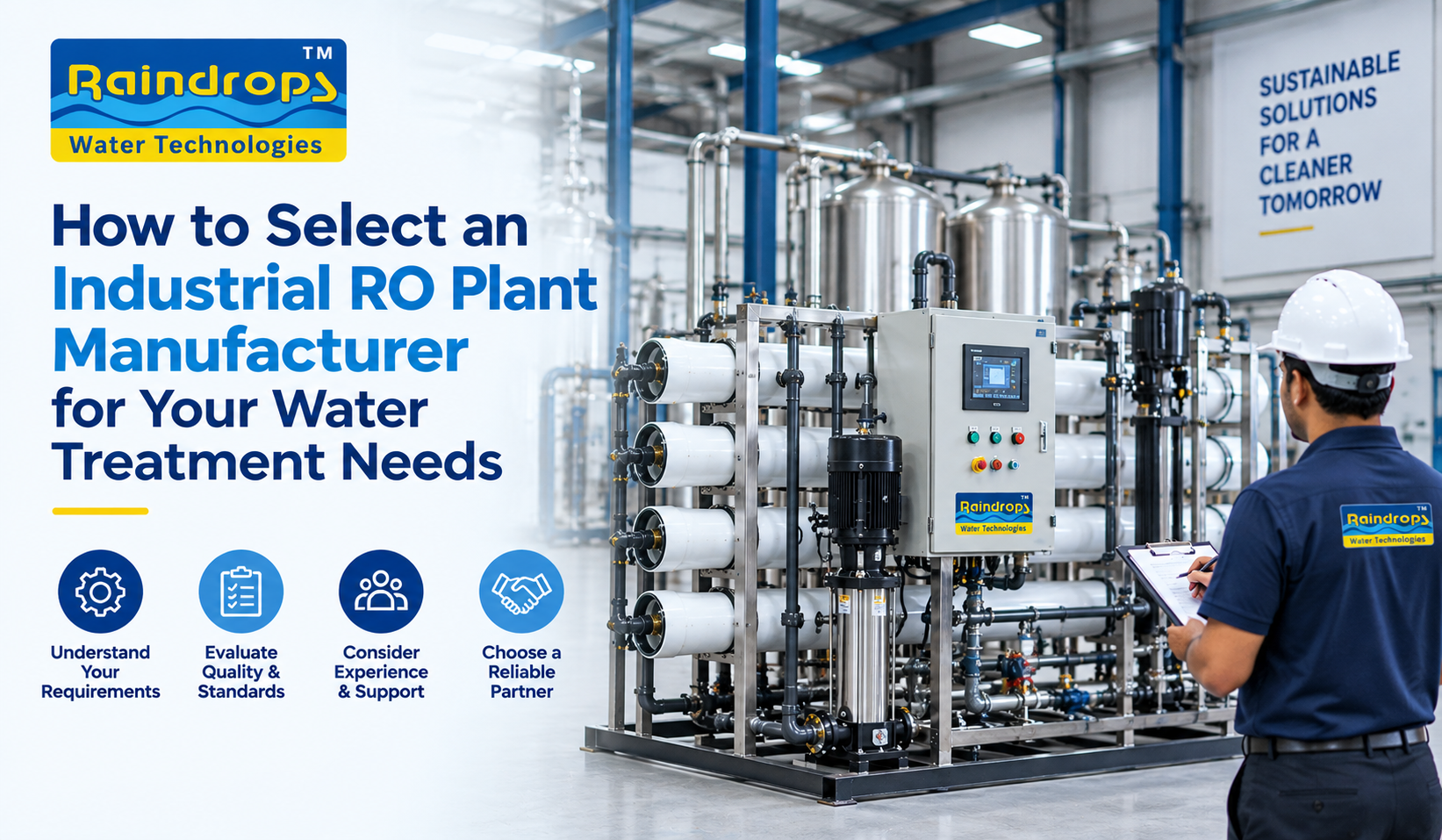
Industrial water treatment decisions involve more than selecting equipment with a suitable capacity. Water quality, process requirements, operating conditions, maintenance needs, and long-term reliability all influence whether a treatment system performs effectively. Businesses looking for an industrial ro plant manufacturer often need to understand these factors before comparing technical specifications or quotations. Raindrop helps place the focus on practical treatment requirements, allowing businesses to consider what their operations actually need rather than relying on capacity alone.
1. Understand the Water Quality Before Selecting Equipment
The first step is to understand the water entering the treatment process. Source water can contain dissolved salts, suspended particles, hardness, organic matter, microorganisms, or other contaminants. Their concentration and variation directly affect treatment requirements.
A water analysis provides useful information for deciding which treatment stages may be necessary. It can also highlight issues that could affect membrane performance, such as excessive hardness or suspended solids.
Industrial users should consider:
- Source and seasonal variation in feed water
- Total dissolved solids and conductivity
- Hardness and alkalinity
- Suspended solids and turbidity
- Microbiological quality
- Required treated-water quality
Without this information, selecting equipment based solely on daily capacity can lead to an unsuitable configuration.
2. Match the RO Plant to the Process
Capacity is important, but it should not be the only consideration when evaluating an industrial RO plant. The system should be matched to how water is consumed within the facility and what quality is required at different points of use.
For example, a manufacturing process requiring low-TDS water may have different treatment needs from a facility using treated water primarily for utilities or general production. Pretreatment may also be necessary to protect membranes and improve system consistency.
| Factor | What to Evaluate | Why It Matters |
|---|---|---|
| Feed water | Quality and variability | Determines treatment requirements |
| Capacity | Daily and peak demand | Prevents under- or oversized systems |
| Recovery | Desired usable-water percentage | Influences reject-water volume |
| Pretreatment | Filtration, softening or other stages | Helps protect the main treatment process |
| Automation | Monitoring and control requirements | Supports consistent operation |
| Maintenance | Access to consumables and components | Affects operational continuity |
A properly matched design considers both present demand and realistic future requirements.
4. Look Beyond Initial Installation
An efficient treatment system needs to remain manageable after installation. Operating costs can come from electricity, replacement components, cleaning, membrane maintenance, pretreatment media, and water losses.
This makes lifecycle assessment particularly useful. A system with a lower initial price may not necessarily be the most economical option if it requires frequent intervention or has higher operating requirements.
Maintenance access should also be considered during planning. Operators need practical access to filters, pumps, membranes, valves, instruments, and other serviceable components. Clear documentation and understandable controls can further simplify routine operation.
The objective is not simply to install a functioning system, but to establish a treatment process that can be monitored and maintained consistently.
5. Assess Technical Expertise and System Design
Choosing an industrial RO plant manufacturer in Ahmedabad should involve more than comparing equipment prices. Technical understanding matters because treatment systems need to respond to actual feed-water conditions and application requirements.
Ask whether the proposed design clearly explains its treatment stages, expected performance parameters, operating conditions, and maintenance requirements. It is also useful to understand what assumptions have been made about feed-water quality and daily consumption.
A sound evaluation should cover:
- Water analysis and treatment objectives
- Equipment capacity and operating range
- Pretreatment requirements
- Expected recovery and reject handling
- Instrumentation and control features
- Routine maintenance requirements
This approach makes comparisons more meaningful because different proposals can be assessed against the same operational criteria.
6. Plan for Reliable Day-to-Day Operation
Once the technical configuration has been established, attention should shift toward practical operation. Operators should know how to monitor key parameters, identify changes in feed-water conditions, and respond to abnormal readings.
Routine records can help identify gradual changes before they become larger problems. Tracking pressure, flow, conductivity, cleaning intervals, and component replacement can provide a clearer picture of system performance over time.
Training is another important consideration. Even a well-designed treatment system can perform poorly if operating procedures are unclear or maintenance is inconsistent.
Businesses should therefore consider the availability of operating manuals, service guidance, replacement components, and technical support when making a final decision.
Frequently Asked Questions
1. What information is needed before selecting a treatment system?
2. Why is pretreatment important?
3. Is higher capacity always better?
4. How can operating costs be evaluated?
5. What should be checked before finalising a supplier?
Conclusion
Selecting industrial water treatment equipment is ultimately a process of matching technology to real operating conditions. Water quality, capacity, pretreatment, recovery, maintenance, monitoring, and lifecycle costs should all be considered together. Businesses comparing an industrial RO plant manufacturer in India can make a more informed decision by evaluating technical suitability and long-term practicality rather than focusing on installation price alone. A well-planned system should support consistent water quality while remaining understandable, maintainable, and appropriate for the facility's actual requirements.


